How TCTSY is Finding an Arabic Voice: Language, Identity, and Community-Led Healing in the Arabic-Speaking World
Oct 08, 2026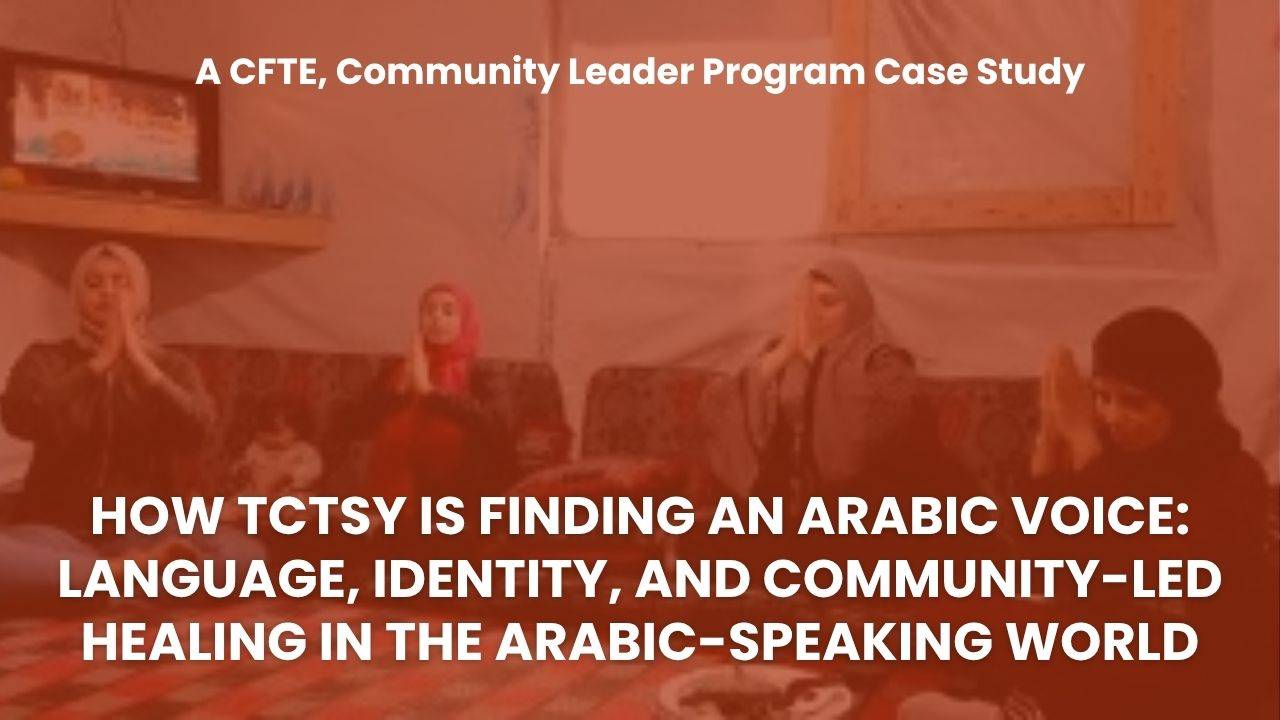
A CFTE / Community Leader Program Case Study
Primary source: Leila Johnson, Project Director, TCTSY Community Leader Program
The Case in Brief
TCTSY arrived in the Arabic-speaking world in 2018. When Leila Johnson traveled to Beq’aa Valley in Lebanon, to work in an unofficial refugee camp, she met Fedaa, now a TCTSY-CL (TCTSY Community Leader). Together they started to glocalize TCTSY and its methodology to meet local expectations. Almost immediately, a foundational challenge emerged; one that had nothing to do with logistics, funding, or safety, and everything to do with language, collaboration, and identity.
What followed was not a translation project. It was something more fundamental: years of collaboration across disciplines, countries, and lived experiences that ultimately added new terminology to one of the world's oldest languages. This is the story of how that happened, why it mattered, and what it made possible.
Three problems arrived in Beq’aa Valley alongside Leila in 2018.
The first was structural. As a white-presenting practitioner from the West, Leila carried specialized knowledge that would leave when she did. That dynamic – knowledge arriving from outside, held by an outsider, departing with the outsider – is itself a form of power asymmetry. An approach that perpetuates it is at risk of reinforcing the very systemic harm it claims to address.
The second was cultural. Yoga may carry complex associations in the Arabic-speaking world: questions of religious acceptability, cultural relevance, and community trust that could not be resolved from the outside. Would this methodology even be accepted?
The third was linguistics. The core theoretical vocabulary of TCTSY, the language practitioners use to learn and offer the methodology, did not yet exist in Modern Standard Arabic. Words like ‘interoception’ and phrases like ‘trauma-sensitive yoga’ had no equivalent. And without language, there is no transmission.
Invitational language (the non-directive, choice-offering grammatical structure that is at the heart of TCTSY facilitation) does not exist in Arabic, and it does not exist in the cultures of the communities this program serves. Phrases like "would you like to..." or "perhaps, as you are ready..." have no cultural home there.
The response to this was not to impose the form. It was to go back to first principles: why does invitational language exist? Its purpose is to provide opportunities for choice-making and empowerment. Armed with that understanding, the team asked: what in Arabic does the same work?
The answer was direct and simple: "you can do this... or that." By Western ears this may sound overly direct. It is not. It is culturally appropriate, clearly understood, and functionally identical — it creates options, preserves agency, and avoids direction. The form changed entirely. The root held.
The Problem: A Methodology Without a Language
What TCTSY requires linguistically
TCTSY is not just a set of yoga shapes. It is a methodology built on specific language — invitational, non-directive, choice-offering language that has the possibility to communicate something very particular to the nervous system of a trauma survivor. The way a facilitator speaks is as clinical as the movement itself. Getting it wrong is not a minor error. It can replicate the very dynamics of coercion that trauma survivors have already experienced.
What Modern Standard Arabic did not have
When the CL program arrived in the Arabic-speaking world, three essential concepts had no equivalent:
- "Trauma-sensitive yoga" (اليوغا المراعية للصدمات النفسية) — the phrase did not exist
- "Interoception" (إِنْتِرُسَبْشِنْ) — the felt sense of internal bodily experience had no word.
- Invitational language — the non-directive, choice-offering grammatical structure had no natural form in Arabic
This was not a translation gap that a bilingual dictionary could close. Body-based practices and traditions exist across the Arabic-speaking world, however the contextualizing of these specific concepts within a trauma-informed framework had not yet been done. The work was not to introduce embodiment to Arabic. It was to build a shared vocabulary that could hold TCTSY's particular methodology within it.
EDITORS NOTE:
Interoception إِنْتِرُسَبْشِنْ is similar to but yet different to perhaps the closely related Arabic words:
- إِدْراكُ جِسْمَ — a (felt) perception and awareness of your body, which can apply to both the inner body and the exterior body experience.
- الاستشعار الداخلي — which could translate to "internal sensing,” possibly a more general, descriptive phrase which may include but is not limited to monitoring blood pressure, hormones etc.
إِنْتِرُسَبْشِنْ / interoceptive awareness is much more specific (also sometimes called the "eighth sense"). It is more specific to “knowing” the inner body sensations in the present moment; focusing on receiving, interpreting, and integrating internal bodily signals into conscious awareness, emotional experiences, and behavioral urges. Such as, it is arguable, the Arabic concept to which may best describe إِنْتِرُسَبْشِنْ interoception is, غُصَة - a word that describes noticing the tight feeling in your throat when you are trying not to cry. Hence, the emphasis of the present moment experience is perhaps an important distinction between other closely related language suggestions.
The deeper complexity: yoga's cultural status
The CL program did not arrive into culturally neutral territory. Every community it entered had its own existing relationship to the idea of yoga — its origins, its associations, its fit or friction with local values and practices. Navigating those relationships required listening before offering, and adapting before teaching. The language work and the cultural work were inseparable from the start.
The Setting: Beq'aa Valley, 2018
Where it began
Beq'aa Valley is approximately 56km from the Syrian border. It is a historic region held by Hezbollah, known geographically for farming and geopolitically for air raids. The majority of Syrian refugees in Lebanon live in extreme poverty (WFP, 2020). Beq’aa Valley has become a displaced land for many self-identified displaced peoples.
In 2018, Leila arrived into this context through an invitation from a grassroots nonprofit working inside the United Nations schools. She was there to offer TCTSY — what became, thanks to Fedaa, a genuine knowledge exchange model. What she did not anticipate was that the experience would shatter her preconceived notions about displacement, refugee identity, and dignity — and that it would become the beginning of an eight-year project that would help to provide income projects for women and the team adding to the Arabic vernacular.
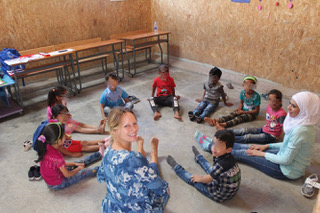
2018, Be'qaa, Leila and fFdaa during their first month together
Fedaa
In Beq'aa Valley, Leila met Fedaa — a Syrian refugee woman who co-facilitated TCTSY sessions with her in a school classroom. What began as a teaching relationship became something more mutual. Fedaa was curious. She was open. She wanted to learn not just how to do TCTSY but how to lead it. And she did.
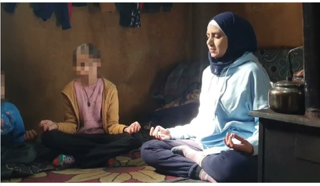
Fedaa's arc is the proof of concept for everything the CL program aims to do. Fedaa moved from participant to TCTSY-Community Leader facilitator to mentor. She now helps to lead train-the-trainer programs across Syria, Lebanon, the West Bank, and Gaza via Zoom, from Beq'aa Valley. She has been involved in three research projects. In 2024, a short documentary filmed by her husband, narrated by her and deeply intimate was released on YouTube. It shows Fedaa facilitating TCTSY with refugee children in a tent. It is the only publicly available visual documentation of the CL program in practice.
Fedaa documentary: youtube.com/watch?app=desktop&v=GxgvQmGB8Xw
Fedaa's identity on screen is layered and deliberate: Woman. Mother. Refugee. Caregiver. Teacher. Community Leader. Muslim. Syrian. Arab. The credential — TCTSY Community Leader — is itself a counter-narrative tool. It expands what the media has collapsed. As Leila writes in her academic paper on identity and self: "language can help shift our perceptions of ourselves and how we navigate and feel in the world."
The Process: How New Words Are Made
Six months of listening before a single session
Before the CL program was formalized, Leila, Fedaa, and Mohammad (a community leader and head of Aida Youth Camp in the West Bank) held weekly Zoom calls for six months. The agenda: what does the community want? What would make this worth doing? What would it need to look like to be theirs? What emerged from those conversations was not primarily a request for yoga. It was a request for leadership: for women to learn how to step into that role and be paid for it, and for identities that had been collapsed by media, by displacement, and by the single word "refugee" to expand again.
The linguistic collaboration
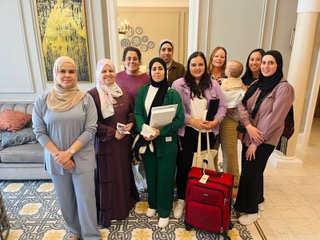
The terminology work that followed was a genuine collaboration. At its center: Farah Al Housami — Leila's co-facilitator, translator, interpreter, and cultural and language expert who has been with the program since 2020. Based in Beirut, where she previously worked on English–Modern Standard Arabic translations, Farah brought both linguistic precision and deep cultural knowledge to the work. She is now a certified TCTSY-Community Leader herself.
Alongside Farah: Professor Mehri, a linguistics scholar at Simon Fraser University, whose academic expertise helped ground the terminology work; and Mohammad Abu Srour, community leader and head of Aida Youth Camp in the West Bank.
Once draft terminology was developed, it was tested in real time with the full community of TCTSY-CLs to feel how it fit, see whether it landed, and refine it through lived experience rather than theoretical construction.
The result: new terms were added to Modern Standard Arabic for trauma-sensitive yoga and interoception. These words are now being used in the language because this community created them.
The glocal framework — not blended, but held equally
Leila's academic work introduces the term "glocalization” as the intellectual frame for this process, but with a crucial distinction. Standard global approaches often merge local and global frameworks into something unified. In contrast, the CL program holds Western research and local knowledge separately but equally — like looking through one eye at each, simultaneously. Leila quotes Mi’kmaw Elder Albert Marshall of the Eskasoni First Nation, who coined the concept, Two-eyed Seeing (an Indigenous, anti-colonial methodology):
“to see from one eye with the strengths of Indigenous knowledges and ways of knowing, and from the other eye with the strengths of Western knowledges and ways of knowing, and to use both of these eyes together for the benefit of all.”
In other words, only when you look equally through both perspectives can you care for the future generations. This is not synthesis, but rather co-existence, and it is the reason the Arabic terminology is a genuine addition to the language rather than an adaptation of English concepts that never quite fit.
What Was Adapted in the Methodology
"Safe enough" replaces "Safe"
The language of creating a "safe environment" — standard in TCTSY training — was replaced with "safe enough environment" and "healing environment," informed by the Harvard Refugee Trauma Program. In active conflict zones, the word "safe" is not just inaccurate — it can be actively triggering. The people in these sessions know what safety is and know it is not available to them. Asking them to create it is a form of denial. "Safe enough" acknowledges their reality and works within it.
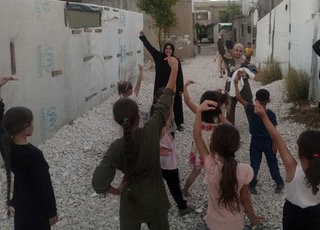
Khansa in Be'qaa
No "Shavasana"
"Shavasana," or final resting form, is removed from all CL program sessions. In environments without adequate clinical support, the possibilities of relaxing the central nervous system too deeply risks triggering panic responses in traumatized bodies. The group does not have the resources to safely hold someone through that. This is a clinical safety decision, not a cultural accommodation.
Drawing as a closing practice
In place of shavasana, drawing is offered as a closing regulation activity. Children are given crayons and paper. Drawing provides a regulated, grounded, settling experience without the physiological risk of deep nervous system relaxation. It also serves as a research data point — before and after drawings are being used in the Aida Refugee Camp (West Bank) pilot study to assess change over time.
Snacks and juice boxes
In communities where children may not have eaten, offering snacks and juice is a form of embodied safety. It signals: you are cared for here. But provisions go further than food.
In the original pilot project, a small donation received from Kylie Jenner Inc. made it possible to purchase local provisions for participants. Among the most transformative were wireless earphones for women in training. In refugee camp settings there is little to no privacy — they are small spaces shared by many people. Learning trauma theory and getting movement instruction, and interoceptive guidance on a cell phone surrounded by your community is a different experience entirely when you are wearing earphones. They created a safer-feeling environment, supported new narratives, and allowed for freer movement.
Also provided to participants attending community leader classes: maxi pads. In some communities, including Beq'aa Valley, menstrual products are not reliably accessible. Offering them made movement feel more available. It changed what was possible in the room.
Salaries for the women and local provisions are among the most important places CL program funding goes. They are not logistics. They are the conditions that make the work possible.
Du'a (دعاء) – prayer as an opening
Some sessions may open with prayer or Du'a (دعاء)", following the lead of community leaders who know their communities. This is not a compromise of the TCTSY methodology. It is the methodology — the invitational, non-coercive approach being applied to the facilitation structure itself.
Al Jawed Camp, Northern Gaza
Hadeel Al-Gerbawi and what she built
The Al Jawed Camp for displaced children in Northern Gaza was founded by Hadeel Al-Gerbawi — an educator and mother who lost her own child in the ongoing conflict and is raising her two surviving sons in the camp. From a personal act of care for children in her immediate community, she built a structured program now serving over 500 children and 15 teachers.
Al Jawed prioritizes math, Arabic, Islam, art, and movement. It incorporates the CL program's trauma-sensitive yoga alongside trauma-sensitive classroom strategies. It is, in Leila’s academic framing, a case study of human rights education — an environment where children rebuild a sense of self, safety, connection, and normal childhood experience during, not after, active conflict.
The research running alongside
The pilot study launched in the United Nations Aida Refugee Camp in the West Bank is the first TCTSY study conducted in an active conflict zone rather than post-trauma, and is directly linked to and supportive of the parallel programs in Gaza, Syria, and Lebanon. It is community-led and woman-led throughout. Initial findings are positive and consistent: children are sleeping better, concentrating more, and developing basic interoceptive awareness. Before and after drawings are being analyzed alongside standard measures. Data analysis is ongoing. A second pilot is being planned, and focused for donations.
Identity Healing as the Frame
Why the credential matters as much as the yoga
Displacement collapses identity. What was once an accordion of identities — woman, mother, teacher, neighbor, Syrian, Muslim, caregiver, friend — gets flattened into a single word: refugee. Media reinforces this. Bureaucratic systems require it. Over time, the single story can become the self-story.
The TCTSY-Community Leader designation does something specific in this context. It is not just a professional credential. It is a counter-narrative. It is an identity for a person other than "refugee." The program is 30 hours in total. Participants who complete it receive a CFTE Certificate of Completion alongside the TCTSY-Community Leader designation. In communities where women face significant barriers to professional recognition and career progression, a certificate from an internationally recognized research organization carries real weight. For many participants, it is the first formal Western credential they have held, as every participant holds a university degree.
It is earned, it is recognized by an international research organization, and it adds to the accordion rather than compressing it. As Leila herself has argued citing Fukuyama (2018): the inner sense of dignity needs recognition. The CL credential is a form of that recognition.
Healing trauma is healing identity
This is the conclusion Leila reaches and the principle that sits beneath the entire program: for people who have experienced displacement, trauma recovery is inseparable from identity recovery. TCTSY's methodology — interoception, invitational language, choice-making, shared authentic experience — creates new ways of being in the body. New ways of identifying with sensation. And through that, new experiences of self.
Why This Matters Beyond the Arabic-Speaking World
A replicable model for global partnership
As CFTE explores bringing TCTSY to India, China, Afghanistan, Iceland and other regions where the vocabulary of trauma-informed embodiment practice does not yet exist, the Arabic language work is the template. It took years, and required sustained relationships, academic collaboration, genuine cultural humility, and a willingness to not know the answer at the start. But it produced something no translation could: a methodology that belongs to the language it now lives in.
Iceland presents a parallel linguistic and cultural situation: invitational language does not exist in Icelandic. CFTE and the CL program are actively working with the University of Iceland on how to adapt the methodology to meet Icelandic cultural and linguistic realities — applying a similar framework that shaped the Arabic work.
CFTE's own research in the loop
Leila's studies draw from Venessa Bowers, Dave Emerson, and Kerry-Ann Williams directly — specifically the 2024 narrative example of TCTSY as an intervention for children and adolescents, published in the ISTSS Newsletter. Bowers' connection to the CL program goes beyond citation: she has taught and facilitated for the program directly, and shared her research with the CL team in 2021 — ahead of wider publication — making her work foundational to what the program draws on. CFTE's research is informing the CL program. The CL program is generating new research that cites CFTE. The circle is progressed, and continues on.
The decolonization question this work analyzes
A non-global educational or therapeutic response to displaced persons risks reinforcing trauma, colonial harm, and oppressive power structures. The CL program's answer is not theoretical. It has been tested in cornfields, in mechanics shops, in UN tents, in Zoom calls interrupted by drone strikes. When done right, it results in new words within a language that didn't have them before.
Active Locations
A brief directory of where the program is currently operating:
SWANA Region (South West Asia and North Africa / Middle East)
Beirut and Beq'aa Valley, Lebanon, Syria, West Bank and North Gaza, Occupied Palestinian Territory.
Canada
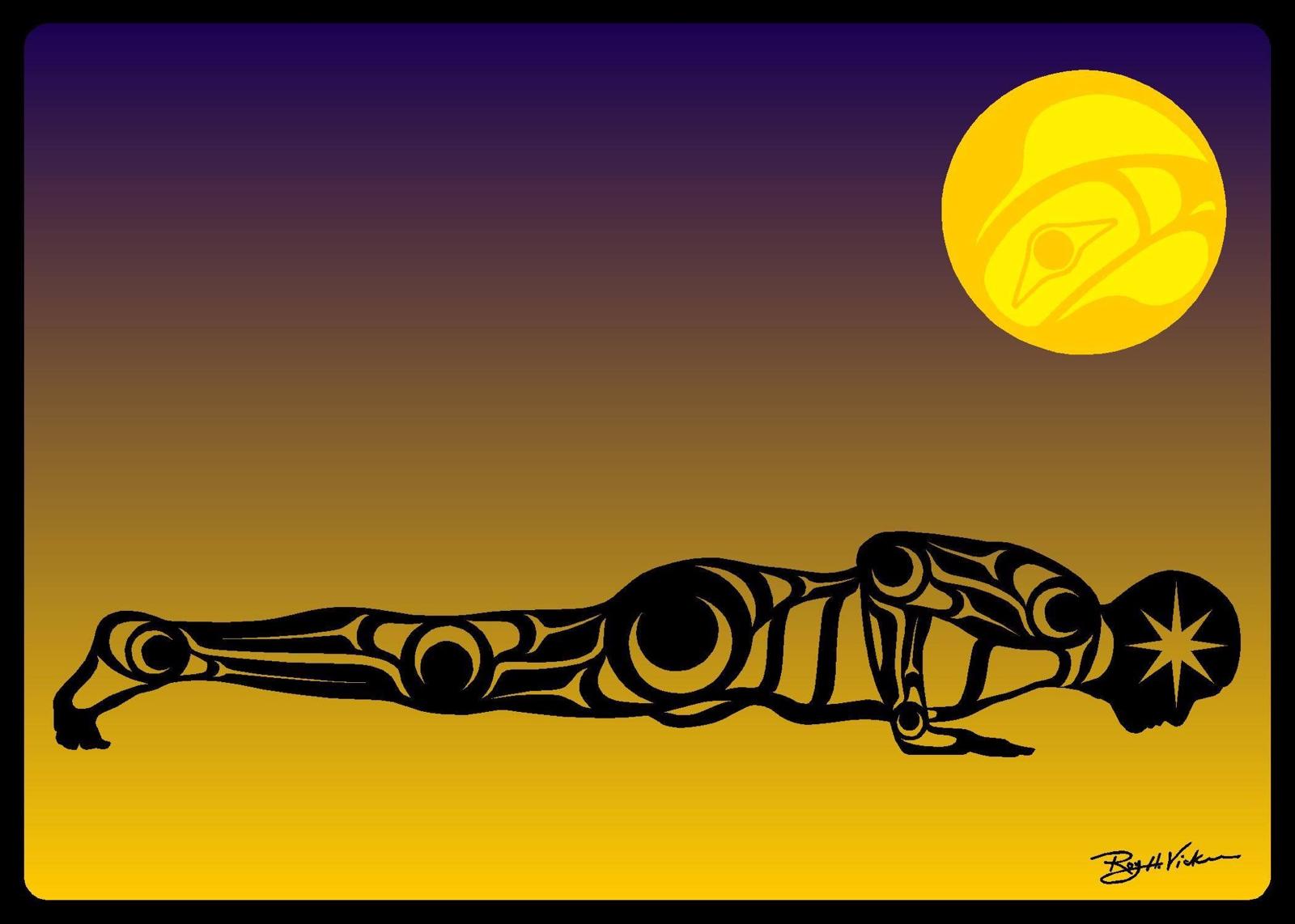
First Nations communities across British Columbia and Ontario — including a collaboration that produced a yoga deck illustrated by Elder Roy Henry Vickers, one of Canada's most celebrated First Nations artists and storytellers.
Upcoming
Pakistan:
The project is in process of translating the TCTSY methodology and its research into Urdu with community leaders, academics, and language experts. It is also in partnership with the National Institute of Psychology, Centre of Excellence, Quaid-i-Azam University, Islamabad, for its research; and in collaboration with acid attack survivors and the School of Human Rights (a project of Voices Against Torture), Islamabad to support displaced children — including a culturally represented yoga deck illustrated by Maria Riaz, an award-winning Pakistani children's book author, illustrator, and founder of WHY Books. Based in Muzaffarabad, Azad Kashmir, Maria is known for bringing local heroes, historical figures, and nature themes to life through her digital art.
Afghanistan:
One of the next CL program activities is with women from Afghanistan, and it is the first project to come out of a new partnership with Yoga Alliance. Yoga Alliance has adopted the CL program as its model for work with communities in crisis and plans to support multiple projects a year, with CFTE continuing to lead the methodology. The project is about to launch next month with the Afghan diaspora community, with weekly TCTSY sessions, deep collaboration, and the glocalizing of materials. The team also hopes to reach, once the first phase is underway, more women and girls inside Afghanistan. The language of this work is Dari, so the program will follow a similar contextualizing process used for Arabic. The TCTSY framework and local knowledge are held side by side. A research assistant at the University of Iceland will track this adaptation alongside the project in Arabic, Urdu, and Icelandic for the next couple of years.
Looking Forward
The Arabic work began with a gap in a language and has grown into a model other communities can use. What comes next builds on the same foundations this case study has traced: a methodology that speaks in the language of the people it serves, leaders who come from the communities where the work happens, and research that tests what the program claims.
Language that belongs to the community. Publication of the Arabic terminology in a peer-reviewed journal is in progress. It will give the new terms for trauma-sensitive yoga and interoception a permanent, citable home and make the process available to anyone who needs to follow it. The same trauma-informed glocalization (TIFG) work is underway in Urdu and Icelandic and is beginning in Dari. A graduate researcher at the University of Iceland is following all of these adaptations over two years to document what they share and where each one has to be entirely local. The aim is a practical blueprint that a new community can pick up without waiting years to learn what the Arabic work learned.
Leadership that stays. The program's answer to the problem Leila met in 2018 is that the people who hold the methodology live where it is practiced. That problem was knowledge that arrives with an outsider and leaves with them. Fedaa moved from participant to facilitator to mentor and now supports leaders across Syria, Lebanon, the West Bank, and Gaza. Each new leader completes 30 hours of training and earns a TCTSY-Community Leader designation, which for many is the first formal Western credential they have held. The CL program is actively seeking funding to expand the number of women it can pay and the number of communities it can reach.
Evidence from inside active conflict. The pilot study in the United Nations Aida Refugee Camp is the first TCTSY study conducted during an active conflict rather than after it. Early findings point to children sleeping better, concentrating more, and developing interoceptive awareness. The data are being analyzed, and a second pilot is being planned.
Growth through partnership. Yoga Alliance has adopted the CL program as its model for work with communities in crisis, and Afghanistan is the first of what is expected to be roughly ten projects a year. Each one will follow the sequence the Arabic work established.
The program welcomes expressions of interest from organizations, funders, teachers, and community leaders who want to explore bringing this work to a new context. A good first conversation looks at what is already in place there, because the first six months in the Beq'aa Valley were spent listening, and the same sequence will apply wherever the program goes next.
CITATIONS:
Ahmed, H. (2025, July 8). Trauma-sensitive yoga helps displaced children in Gaza cope with the psychological toll of Israel's genocide. The New Arab. https://www.newarab.com/features/yoga-offers-displaced-gazan-children-way-heal-amid-genocide
Bartlett, C., Marshall, M., & Marshall, A. (2012). Two-Eyed Seeing and other lessons learned within a co-learning journey of bringing together Indigenous and mainstream knowledges and ways of knowing. Journal of Environmental Studies and Sciences, 2(4), 331–340.
Bowers, V. A., Emerson, D., & Williams, K.-A. (2024). A narrative example of Trauma Center Trauma Sensitive Yoga (TCTSY) as an intervention for behavioral health outcomes in children and adolescents. International Society for Traumatic Stress Studies Newsletter. [link to confirm]
Fukuyama, F. (2018). Identity: The demand for dignity and the politics of resentment. Farrar, Straus and Giroux.
Johnson, L. (2026a, April 16). Reshaping personal identity and belonging: Trauma, displacement, and the expanded refugee narrative in a train-the-trainer approach [Unpublished course paper, INT202]. University of Iceland.
Johnson, L. (2026b, April 28). Trauma-sensitive classroom strategies and human rights education: A glocal educational response for displaced children in Gaza [Unpublished course paper, INT203G]. University of Iceland.
Mannion, G. (2015). Towards glocal pedagogies: Some risks associated with education for global citizenship and how glocal pedagogies might avoid them. In J. Friedman, V. Haverkate, B. Oomen, E. Park, & M. Sklad (Eds.), Going glocal in higher education (pp. 19–34). University College Roosevelt.
Nguyen-Feng, V., Lapolice, E., Houssami, F., Johnson, L., Hamoud, K., Almudahi, F., & Makboul, A. (2024). Community-led Trauma Center Trauma-Sensitive Yoga: Interrupting cycles of trauma in the refugee experience. Voices Against Torture Journal. https://www.vastbc.ca/articles/community-led-trauma-center-traumasensitive-yoga-interrupting-cycles-of-trauma-in-the-refugee-experience
World Food Programme. (2020, December 18). Nine out of ten Syrian refugee families in Lebanon are now living in extreme poverty, UN study says. https://www.wfp.org/news/nine-out-ten-syrian-refugee-families-lebanon-are-now-living-extreme-poverty-un-study-says
Zerrouky, M. (2024, October 17). In Lebanon's Beqaa Valley, Hezbollah's historic stronghold: "There's nothing but distress." Le Monde. https://www.lemonde.fr/en/international/article/2024/10/17/in-lebanon-s-beqaa-valley-hezbollah-s-historic-stronghold-there-s-nothing-but-distress_6729686_4.html